Weekly Notes: legal news from ICLR, 14 July 2025
This week’s roundup of legal news includes inquiry reports on the Post Office IT scandal, the criminal courts, fraud, and social media misinformation. Plus recent case law and commentary.… Continue reading about Weekly Notes: legal news from ICLR, 14 July 2025
Recent inquiry reports
Post Office IT scandal
‘Swift action to deliver full and fair compensation’ has been called for by Sir Wyn Williams in his ‘urgent’ Report into the Post Office Horizon IT Inquiry (HC1119), delivered last week.
This first volume of the report focuses on the human impact of the scandal. It makes reinforces what we already knew from extensive previous reporting and litigation, that owing to ‘bugs, errors and defects’ in the Horizon IT system supplied by Fujitsu to the Post Office, ‘many hundreds of people have been convicted, wrongly, of criminal offences, and many thousands of people have been held responsible, wrongly, for losses which were illusory, as opposed to real’.
Moreover, ‘all of these people are properly to be regarded as victims of wholly unacceptable behaviour perpetrated by a number of individuals employed by and/or associated with the Post Office and Fujitsu from time to time and by the Post Office and Fujitsu as institutions”.
Sir Wyn makes 19 urgent recommendations to resolve issues that are hindering full and fair redress for the victims, including that:
- The Government and the Post Office should agree on a definition of ‘full and fair’ compensation, and this should be followed when deciding the level of compensation to offer.
- Horizon Shortfall Scheme claimants should receive legal advice, funded by the Government.
- Close family members of people affected by the Horizon scandal should receive compensation.
- Fujitsu, Post Office and the Government should publish a report by 31 October 2025, outlining a programme for restorative justice (or the actions they’ve taken so far to produce this programme).
There is also a more general recommendation, which has no doubt been informed by the plight of many other victims of various forms of public maladministration or worse, namely:
- The Government should create a standing public body which will create, administer, and deliver schemes for giving financial redress to people who have been wronged by public bodies.
See also: Summary of the report and News story
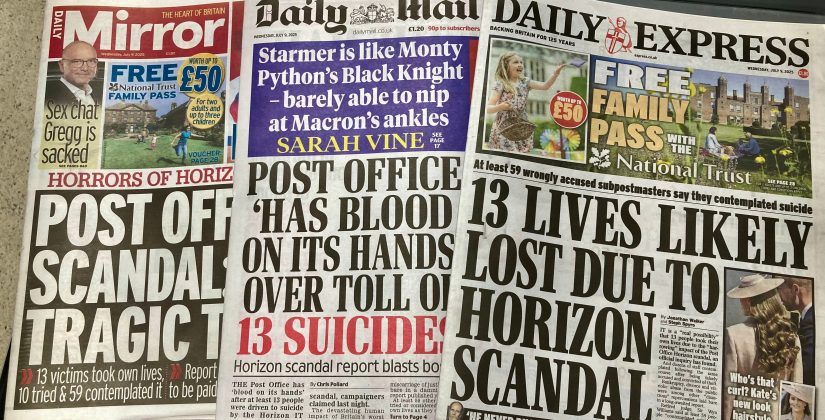
News coverage of the report (see image) has focused on some of the more catastrophic effects on the victims, including a number of suicides, cases of alcohol addiction and ruined lives; also a number of victims have died without having received any compensation.
Post Office Scandal (Nick Wallis blog): Now at least thirteen suicides directly linked to Post Office Scandal
The Guardian: Post Office Horizon IT scandal: five things we learned from the report
Department for Business and Trade: Post Office Minister responds to Horizon IT Inquiry report (commending the report to the House of Commons and outlining what this new government has done to increase and speed up the payment of compensation).
Criminal courts
Another big report last week: Part 1 of The Independent Review of the Criminal Courts, led by the former Lord Justice, President of the Queen’s Bench Division and Head of Criminal Justice, Sir Brian Leveson. This report is only the first part of the review (the Policy Review). Part II (the Efficiency Review) will be published later in 2025.
Nevertheless this report is important because it suggests major changes to the way criminal cases are tried, most notably in proposing a middle tier of courts between magistrates’ courts and the Crown Court, to be known as the Crown Court Bench Division, in which cases that could have been tried either by magistrates or by a jury (triable either way offences) with a sentence of up to three years’ imprisonment could instead be tried by a judge sitting with two magistrates.
Among the other recommendations is for certain cases to be tried by a judge alone, either at the election of the defendant or, in cases of exceptional length or complexity, at the direction of a judge; for many smaller cases to be dealt with by way of out of court resolutions (OOCRs); and for an increase in the allocation of sitting days in the Crown Court to 130,000 per year.
“Based on the recommendations that have been modelled (restriction of the right to elect, reclassification, and the CCBD) it is estimated that these alone would save approximately 9,000 sitting days in the Crown Court each year, by diverting cases to the magistrates’ court or the CCBD, where they can be heard in a more timely manner. This would mean a jury is reserved to hear the most serious cases.”
The report cites a lot of caselaw, as you might expect, and quite a few of the cases have been the subject of commentary in Blackstones Criminal Practice. We thought it would be useful to provide a list of the cases cited, with links to ICLR’s index information and content relating to those cases, and links to the commentary. You can find it here: Independent Review of the Criminal Courts: cases cited
The report was widely covered in the media, nowhere more alarmingly than by Michael Mansfield KC in The Observer: If we don’t fight for our juries, trial by AI is coming
Social media misinformation
The Science, Innovation and Technology Committee has published its second report of the session, on Social media, misinformation and harmful algorithms (HC 441). The report focuses on the technological aspects of online services and markets that can lead to the amplification of false, unfounded or harmful information. It is highly critical of the current regime of online content regulation and suggests that legislation such as the Online Safety Act 2023 will never be enough to address the risks from ever more rapidly changing technology, such as generative AI.
“Our concerns were exacerbated when we questioned representatives of regulators and the government, as we were met with confusion and contradiction at high levels. It became clear that the UK’s online safety regime has some major holes.”
Looking at last summer’s violent unrest, fuelled by online misinformation about the Southport murders, the report notes that even if the Act had been fully in force at the time, it would have made little difference.
“Moreover, the Act is already out of date, failing to adequately address generative AI — a technology evolving faster than governments can legislate — which could make the next misinformation crisis even more dangerous. Regulating technology alone is not sufficient — our online safety regime should be based on principles that remain sound in the face of technological development.”
It identifies “five key principles that we believe are crucial for regulation of social media and related technologies”, namely:
- Public safety: Algorithmically accelerated misinformation is a danger that companies, government — both national and local, law enforcement, and security services need to work together to address.
- Free and safe expression: Steps to tackle amplified misinformation should be in line with the fundamental right to free expression.
- Responsibility: Users should be held liable for what they post online, but the platforms they post on are also responsible.
- Control: Users should have control over both their personal data and what they see online.
- Transparency: The technology used by platform companies should be transparent, accessible and explainable to public authorities.
Public sector fraud
Whereas the illusion (or as we now might call it, hallucination) of fraud by Fujitsu’s programme was what led to the Post Office IT scandal, there remains a serious problem with actual fraud and error in the public sector, as the National Audit Office (NAO) has pointed out in its latest report, Using data analytics to tackle fraud and error (HC 988).
Introducing the report, the NAO says “We estimate that fraud and error cost the taxpayer between £55 billion and £81 billion in 2023–24”. The report examines how well placed government is to seize the opportunity offered by old and new data analytics technologies (including AI) to tackle fraud and error on such a scale.
“The Public Sector Fraud Authority (PSFA) needs to help government to step up to the challenge by working with departments and their arm’s-length bodies to innovate and generate significant fraud and error savings. But it cannot do this alone.
The Government Digital Service (GDS) needs to make sure its work facilitates fraud and error analytics, as this is such a significant component of its vision for achieving cost savings through digital government.”
See also: press summary.
Recent case summaries from ICLR
A selection of recently published WLR Daily case summaries from ICLR.4
COSTS — Detailed assessment — Appeal: Ward v Rai, 03 Jul 2025 [2025] EWHC 1681 (KB); [2025] WLR(D) 352, KBD
EMPLOYMENT — Contract of employment — Agency worker: Ryanair DAC v Lutz, 08 Jul 2025 [2025] EWCA Civ 849; [2025] WLR(D) 358, CA
ENVIRONMENT — Forestry — Restocking notice: R (Wickford Development Co Ltd) v Secretary of State for Environment, Food and Rural Affairs, 10 Jul 2025 [2025] EWCA Civ 882; [2025] WLR(D) 362, CA
EXTRADITION — Appeal — Bar to extradition: Tribunal Judicial da Comarca de Lisboa Norte, Republic of Portugal v dos Santos, 08 Jul 2025 [2025] EWHC 1743 (Admin); [2025] WLR(D) 359, KBD
EXTRADITION — Appeal — Fresh evidence: Mohammed v Law Court of Arad, Romania (Oprea v Bucharest Regional Court, Romania), 02 Jul 2025 [2025] EWHC 1671 (Admin); [2025] WLR(D) 353, KBD
FOOD AND DRUGS — Food — Slaughter of animal: R (Alec Jarrett Ltd) v Bristol Magistrates’ Court, 10 Jul 2025 [2025] EWHC 1674 (Admin); [2025] WLR(D) 363, KBD
IMMIGRATION — Leave to enter — Family member: Ahmad v Secretary of State for the Home Department (Rafiu v Secretary of State for the Home Department), 03 Jul 2025 [2025] EWCA Civ 829; [2025] WLR(D) 349, CA
JUDICIAL REVIEW — Court’s jurisdiction — Attorney General: R (Campbell) v Attorney General, 01 Jul 2025 [2025] EWHC 1653 (Admin); [2025] WLR(D) 344, KBD
LANDLORD AND TENANT — Repairs — Service charge: Adriatic Land 5 Ltd v Long Leaseholders at Hippersley Point, 08 Jul 2025 [2025] EWCA Civ 856; [2025] WLR(D) 361, CA
PRACTICE — Documents — Inspection and copying: In re HMP (Children) (X & Y v BBC), 01 Jul 2025 [2025] EWCA Civ 824; [2025] WLR(D) 351, CA
Recent case comments on ICLR
Expert commentary from firms, chambers and legal bloggers recently indexed on ICLR.4 includes:
UK Human Rights Blog: Challenge to export of military parts that might be used by Israel fails in the High Court: R (Al-Haq) v Secretary of State for Business and Trade [2025] EWHC 1615 (Admin), KBD
Law & Religion UK: Burial in the wrong plot — a cautionary tale: Re An Exhumation [2025] ECC Por 1, Const Ct
QMLR: Bailey v (1) Bijlani (2) MBNA Ltd [2025] EWHC 175 (KB) and medical treatment claims under the Consumer Credit Act 1974: Bailey v Bijlani [2025] EWHC 175 (KB), KBD
A Lawyer Writes: Justice delayed is bad… but justice denied is worse, appeal judges say: R v BOD [2024] EWCA Crim 1357, CA
UK Human Rights Blog: The Begum Legacy: the Supreme Court further tightens the reins on citizenship deprivation appeals: U3 v Secretary of State for the Home Department [2025] UKSC 19; [2025] 2 WLR 1041; [2025] WLR(D) 260, SC(E)
Law & Religion UK: Burial of a baptismal font — some considerations: In re St Paul, Heslington [2025] ECC Yor 1, Const Ct
3PB: The Upper Tribunal gives guidance on the burden of proof in s.15 disability discrimination claims: B & Anor v The Proprietor of St Dominic’s Grammar School [2025] UKUT 48 (AAC), UT
Local Government Lawyer: Court of Appeal hands down ruling on matters that can be raised on appeal of review decision dealing with suitability of accommodation: Socrattes Ofori-Addo v Haringey London Borough Council [2025] EWCA Civ 277; [2025] WLR(D) 161, CA
Cambridge Law Journal: Illegality and insanity in tort law: Lewis-Ranwell v G4S Health Services (UK) Ltd [2024] 1 WLR 2775, SC(E)
Tanfield chambers: Bad drafting or giving effect to Parliament’s intention?BDW Trading Ltd v Ardmore Construction Ltd [2025] EWHC 434 (TCC); [2025] WLR(D) 148, KBD
Cambridge Law Journal: Reasonable accommodation for disabled university students: University of Bristol v Abrahart [2024] EWHC 299 (KB); [2024] IRLR 396; [2022] PIQR 17 (CC), KBD
Cambridge Law Journal: Economic torts and injured feelings: George v Cannell [2024] UKSC 19; [2024] 3 WLR 153; [2024] 4 All ER 431; The Times, 12 August 2024; Press summary, SC(E)
Tip of the week
Legislation on ICLR.4
Selecting Legislation from the main home page menu brings up the Legislation search page:

The legislation search form allows you to search for any current UK statutes, statutory instruments and retained EU legislation published by The National Archives on legislation.gov.uk, the official online source of UK legislation. The search retrieves the latest updated version from The National Archives and displays it on our website.
All primary legislation from 1988 to the present day is available on this site, as well as most pre-1988 primary legislation that is still in force and most local, private and personal Acts.
You can search by title (including the year if you have it), or separately by year, or range of years/dates of enactment, by number, or by any words or phrases included anywhere in the text of the publication.
You can also filter the search by language (English or Welsh), or by legislation type: the default search includes primary and secondary UK legislation but not retained EU legislation, but any combination can be selected.
For searches by title, bear in mind that a statute with a common name, such as “Companies Act”, may bring in multiple results from different years, as well as statutory instruments amending or brining different parts of a statute into force.
You can also go directly to relevant legislation via links (coloured purple) in the text of a judgment or case report, or from any titles listed under Legislation Considered on the Case Info page.
- For more information about using legislation on our site, see Looking for Legislation in our Knowledge section.
That’s it for this week. Thanks for reading, and make sure you’re signed up for our email alerts. You can also follow us on BlueSky and LinkedIn
This post was written by Paul Magrath, Head of Product Development and Online Content. It does not necessarily represent the opinions of ICLR as an organisation.
Featured image: News coverage of the Post Office Horizon IT Inquiry report (photo via Shutterstock)