The art and craft of judgment writing – second edition
We review the new and expanded edition of a book on every aspect of writing judgments… Continue reading about The art and craft of judgment writing – second edition
This is the second edition of Irish judge Max Barrett’s Primer For Common Law Judges on a topic that no judge can afford to ignore. For it is in writing judgments that judges justify their decisions and therefore also their primary role in the administration of justice.
The first edition of this book was reviewed here by a barrister, Lucy Reed KC, who sometimes also sits as a judge, so has first hand knowledge of the practicalities of writing and using judgments. I myself reviewed Barrett’s follow-up book on the literary approach to legal writing, Great Legal Writing – lessons from literature, which made the point that judgments and other forms of legal writing could also aspire to be readable for their own sakes, and that their artistic qualities may have been overlooked.
Talented writers
This new edition of The Art & Craft of Judgment Writing has been expanded to include an extra section featuring ‘Some lessons from talented writers’. Some of these were briefly discussed in the original edition, and many more were featured in the Great Legal Writing volume. Some of the material from that volume has migrated to this new edition of the earlier book.
For example, the section on Thomas de Quincey (1785–1859) repeats his observations on the importance of style and the need for care, albeit in a slightly shorter version. He also repeats the same quotation from de Quincy about footnotes (with which I must say I sympathise), questioning
“how far the practice of footnotes … is reconcilable with the laws of just composition … how far … such an excrescence as a note argues that the sentence to which it is attached has not received the benefit of a full development for the conception involved; whether if thrown into the furnace again and re-melted, it might not be so recast as to absorb the redundancy which had previously flowed over into a note”.
Footnotes in judgments cause nothing but trouble for law reporters, and they are a pain to display online. I could say, but I will stick to my (being) brief.
In reviewing Great Legal Writing, I commented that all the authors were old and only one of them wasn’t a man – Virginia Woolf. This new edition of The Art & Craft of Judgment Writing includes an expanded section on Edith Wharton, and introduces another, rather less well known, female author, Anna Barbauld.
Wharton (1862–1937) is primarily known for her novels such as The Age of Innocence and The House of Mirth, delineating the social hypocrisies of the Gilded Age, but what I found interesting here were her comments about short story writing. Barrett quotes her saying that “Every phrase” in a short story, “should be a sign-post, and never (unless intentionally) a misleading one: the reader must feel that he can trust to their guidance”. Likewise, says Barrett, “in a judgment, every phrase should point towards the conclusions. Unlike a short story, no element of a judgment should seek to mislead.”
He also notes that “When it comes to economy of prose (‘Most beginners crowd into their work twice as much material … as it needs’), as well as prose that has been reduced to its most economical, Wharton writes that ‘the shorter the story’ – or (it is submitted) the shorter the judgment – ‘the more stripped of detail [it is] … the more it depends for its effect not only on the choice of what is kept when the superfluous has been jettisoned, but on the order in which these essentials are set forth’.”
Barbauld (1743–1825) is described as “a prominent woman in a male-dominated age” and credited with having, in her critical essays, “succeeded in legitimising” the “burgeoning artform” of novel writing. Quoting from her remarks about the novel, Barrett observes:
“in a well-written novel, ‘[e]very incident … is introduced for a certain purpose, and … to forward a certain plan’. The same assertion might be made in respect of the well-written judgment. If a novel is ‘an epic in prose’, a judgment might be described as a novella or short story of fact and law.”
All these points are well made, but they are fundamentally points about good writing generally. The quotations from these and other authors, mostly long dead, are interesting and may prompt a return to the bookshelf or bookshop for their work. But as I said in my last review, none of the featured authors could be considered remotely modern or contemporary. If we can have Mark Twain, why not Percival Everett? Why not Ian McEwan, or Jeanette Winterson?
Practical matters
But that’s a diversion. The real value of this vastly expanded new edition of The Art & Craft of Judgment Writing lies in the additional practical material it contains, bringing the original volume up to date with, in particular, new sections on artificial intelligence (AI), the use of visual aids, and the use of gender-inclusive language. There’s also a whole section on footnotes, to which I was tempted to respond, look at de Quincey!
But what about AI? This is the cutting edge of information technology, at the moment, but it is double-edged and often blunt.
“AI can be used to streamline the judgment-writing process by automating routine tasks, providing some data analysis and ensuring text-wide consistency and accuracy.” But take care. “As to accuracy, as can be seen from the examples shown above, AI may assist in reducing human error. However, thus far, it has a notable error rate of its own.”
While it is clear that when talking about AI, Barrett is including a number of aspects such as natural language processing, machine learning, and predictive algorithms, that may be considered “traditional” AI, it is the more recent development and widespread use of generative AI in conjunction with large language models that is causing the most anxiety, particularly over its tendency to produce “hallucinations” or made-up facts, citations etc.
Barrett quotes extensively from recent judicial guidance on this particular form of AI, noting that while such models may be good at summarising large bodies of text or performing administrative tasks such as drafting emails or memoranda, they should not be relied on for legal research or analysis. Moreover, any outputs from an AI model need to be carefully checked for accuracy.
Barrett urges caution in using AI to write judgments, but much of what he says generally about AI seems to be concerned with AI as it was thought of before the likes of Chat-GPT. Though he mentions “fictitious citations” in passing, there is no detailed consideration of the issue which has come to dominate legal discussion around AI. (To put it in a nutshell, what is the risk of a judge, when giving judgment in a case in which fictitious citations have been put before the court, of referring to those citations in their judgment, thereby polluting the common law record with the very content the judgment is designed to expunge from it?) That will perhaps be something to cover more comprehensively – along with any other gremlins that crawl out of the machinery – in the next edition.
Barrett goes on to consider, in a separate section, the ‘Ethics of using AI in judgment writing’. Again, this is largely concerned with matters such as data bias and transparency that gave rise to concern in relation to the pre-generative forms of AI. It addresses concerns such as the risk of undermining the perception of judicial independence. Like practitioners, judges need to be clear about when they are using AI tools, and for what purpose, and the system as a whole needs to remain both human-centred and accountable.
As to gender-inclusive language, Barrett supports this for a number of reasons, including:
“Fourth, judgments and related commentary cannot continue to be written as though the authors did not live in a world where some people – as is their right – identify as, for example, agender, bigender, gender expansive, genderfluid, genderqueer or transgender. Those people are entitled, as a matter of personal respect, not to be misgendered in a judgment concerning them.”
No doubt he’s right, but it will be interesting to see whether UK judges continue to be as accommodating, following the Supreme Court’s decision in For Women Scotland v Scottish Ministers [2025] UKSC 16; [2025] 2 WLR 879.
Finally, and on an even lighter note, I was a little surprised to see, in the section on visual aids, an icon of a gavel, illustrating a definition of the duty of care. Gavels are not used in Irish courts, any more than in those of the UK, but we do often cite the example of using a sledgehammer to crack a nut, which is perhaps what I am doing now. You’re very welcome!
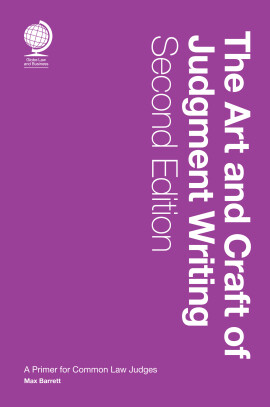
The Art and Craft of Judgment Writing, Second Edition
A Primer for Common Law Judges
Globe Law and Business: 2025
Featured image: Photo by Suzy Hazelwood, via Pexels