The birth of law reporting
In this guest post, Victoria Barnes reflects on the history of law reporting and Lord Nathaniel Lindley’s central role in its development.… Continue reading about The birth of law reporting
Before the birth of modern law reporting in the late nineteenth century, law was reported in many different ways. Lawyers would pick up the newspapers and see the latest cases. Cases appeared in legal periodicals and journals as one might expect. The form was, however, surprising. What appeared here, though, were full reports of cases rather than what we might see today as expositions and case commentaries. Lawyers would, alternatively, pick up the latest digest on a topic to learn about the case law. We would call a digest a casebook today and they appeared in exactly the same form, except that a digest contained new and never heard before cases. The detail there was not intended to give a fuller account of the law to help students. The detail there could be groundbreaking, even for seasoned practioners. Lawyers would also create manuscript accounts of cases. These sources were sought after resources and soon traded among those in the profession. There was good reason that these resources were so keenly exchanged. Access to a library with law journals, digests and legal treatises could give one an insight into the law and an overview of it. But, as information about cases was not openly available to all, informal links became intertwined with the ability to learn more about the common law. This, of course, mattered. The stronger the lawyer’s legal research, the more likely he was to argue persuasively and eventually win his case.
Some of those manuscript accounts of cases would become law reports. With this haphazard system of recording common law decisions, there was perhaps unsurprisingly a great deal of variety. Law reports were known by the author’s name; they featured one court or maybe several and a range of different, often non sequential, years. The author’s name became a by hand for the perceived quality of the report itself, with each report (or reporter) known for their accuracy (or lack thereof). Those reports with poor repute were used less favourably. A famous example that all first year contract students will know is the case of Stilk v Myrick (1809) 2 Camp 317; 6 Esp 129 on consideration. The two reports, written by Campbell and Espinasse, differ wildly. The differences mean that both accounts cannot be true. The reason for their divergence is explained easily. It comes from the unreliable method of reporting. Barristers, who sat in court, simply listened and made their own handwritten notes of the case. They then developed it into a report. There were no formalised checks of quality or to verify the information. Plenty could – and did – go awry here; the notes could have been taken in shorthand or with scanty detail and be either misunderstood or embellished in the writing up stages.
This method of law reporting came to be overhauled in the late nineteenth century. The Incorporated Council of Law Reporting for England and Wales was created in 1865 to make these changes. Lawyers were not so dissatisfied with the quality because poor reports and reporters could be avoided. The lack of organisation and coordination could not be so easily remedied. The interest in systematising came from the then prevailing interest in science among lawyers and the upper middle classes, more generally. Study, for a scientist, meant classifying plants, animals etc and linking different items together through theory. In sum, it gave rise to organising principles. A prominent example is Charles Darwin’s The Origins of the Species which was published in 1859. In civil law jurisdictions, legal science was also taking off. The current method meant that key cases passed unreported. Unless a lawyer happened to be in the room to make notes, the case would not be reported. By the same token, when a lawyer happened to be in the room to make notes, the case — even if it did not change the law – might well be reported.
There can be no doubt that personality played a role here: judges would want their judgments, when thought to be profound, to be recorded in such a way and to have their legal dictum set down for prosperity. As much as individuals and individual personas did matter, so did the collective. The legal profession at this point in time was coming into its own. This is equally true of other professions. The Institute of Chartered Accountants in England and Wales was established in 1880; its counterpart in Scotland was set up in 1854. The Institute for Bankers was founded in 1879. Groups, such as these sought, to set harmonise education, training and standards as well as give rise to a shared culture. These efforts were largely allied to the notion of self-regulation, whereby the group sought to regulated itself. It went alongside the development of laissez faire economics.
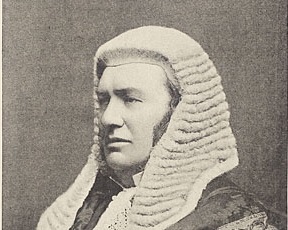
Nathaniel Lindley (29 November 1828 – 9 December 1921) played a central role in the development of law reporting. He wrote a paper in 1863, which set out the principles through which law should be reported. They remain in use today. Lindley was not at this point a judge; he did not become a judge until 1875. Lindley was a barrister in Chancery, having been called to the bar in 1854. His interest in systematising and organising came from his family and his study of the civil law tradition. His father was John Lindley, a professor of botany at University College in London. He specialised in identifying species of orchids. Nathaniel Lindley published An Introduction to the Study of Jurisprudence in 1855, which was a translation of Thibaut’s System des Pandekten Rechts. Thibaut’s text aimed, like German legal writers of the time, to codify; it was a text that intended to classify, organise and systematise principles of law.
Lindley’s aim to revolutionise law reporting may well be forgotten. The pre-1865 system of law reporting seems chaotic, muddled and perhaps even incredulous to a lawyer working today. As a judge though, Lindley’s work remains well remembered. His judgments in Carlill v Carbolic Smoke Ball Company [1893] 1 QB 256, Allen v Gold Reefs of West Africa Ltd [1900] 1 Ch 656 and as a judge the court of appeal in Salomon v A Salomon & Co Ltd [1896] UKHL 1 to name a few are still dissected and used by those seeking to understand the law today. Without the formation of the Incorporated Council of Law Reporting for England and Wales in 1865, these judgments may not have been reported. While Lindley and his contemporaries work to overhaul law reporting may well be forgotten, the result of their efforts is not.
Victoria Barnes is a Reader of Commercial Law and an Associate Dean of Education in Faculty of Arts, Humanities and Social Science at Queen’s University Belfast. She works on the history of commercial and company law and has written about Nathaniel Lindley on numerous occasions.